Guide
Wax Seal History: From Clay Stamps to Wedding Invitations
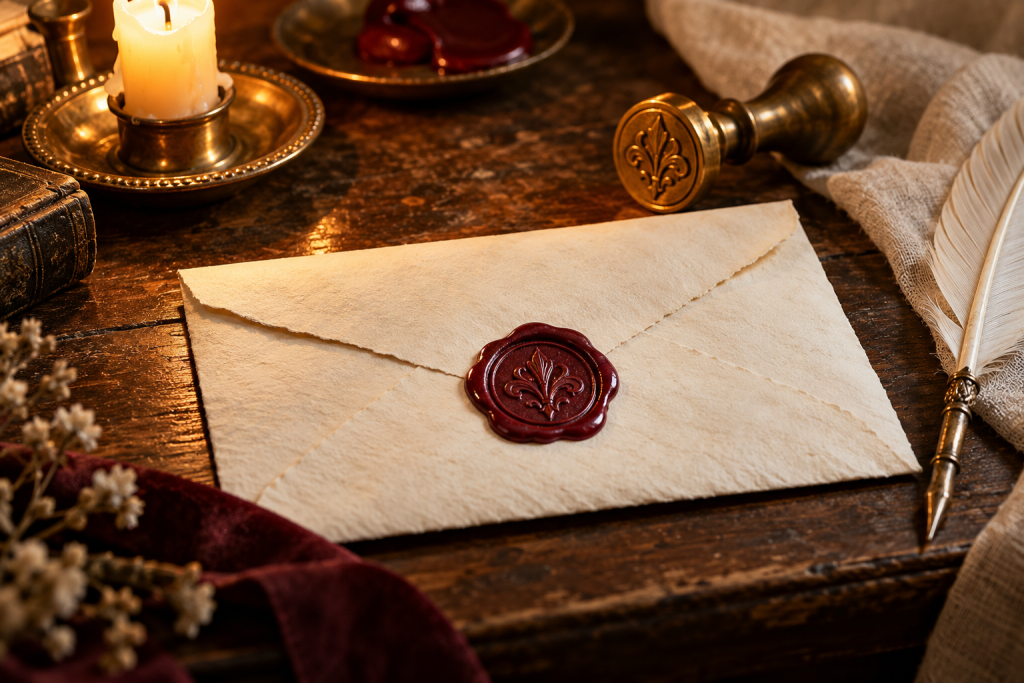
Wax seals began as a practical answer to a simple problem: how do you close a letter and show that nobody has opened it? Stamp seals pressed into clay are known from at least the 6th millennium BC, wax seals were in regular use at royal courts in western Europe by about the end of the 10th century, and the habit spread to ordinary people over the next few hundred years. Once envelopes with gummed flaps and adhesive postage stamps arrived in the 19th century, the seal slowly changed from a security measure into a mark of ceremony, which is exactly how we use it today.
This guide walks through that story in order, with the source named in each section so you can check it yourself.
Seals before wax
Stamp seals and clay
The idea of pressing a personal design into soft material is far older than wax. According to Wikipedia’s article on seals, stamp seals were known at least since the 6th millennium BC, and the oldest ones were button-shaped with simple ornamental designs cut into them. In Mesopotamia, carved cylinder seals could be rolled across wet clay to leave an impression that could be repeated as often as needed, and those impressions served as labels on trade goods, among other uses.
Other materials
Clay was not the only choice. The same source notes that Han dynasty seals in East Asia were impressed in soft clay, and that from the Tang dynasty onward red cinnabar ink was normally used instead. In medieval Europe, lead seals called bullae were common for a time, and Byzantine emperors sometimes issued documents with gold seals. Wikipedia adds that in western Christendom the lead seal fell out of favor, except for papal bulls.
What all of these share is the principle we still use with a wax seal stamp: a carved matrix that leaves the same recognizable mark every time.
Sealing wax in medieval Europe
What the wax was made of
Medieval seal wax was not the same product as modern sealing wax. Hampshire Archives Trust describes the wax on its historic documents as a mixture of beeswax, an ingredient acting as a pigment, and at times a form of turpentine or resin. Wikipedia’s article on sealing wax adds that the Middle Ages version was mostly beeswax and Venice turpentine, a resinous extract of the European larch, and that the earliest version was uncolored. Medieval wax was later colored red with vermilion.
Who used it, and when
Wikipedia’s article on seals states that most western royal chanceries used wax seals fairly regularly by about the end of the 10th century. From there the practice moved down the social ladder: to petty knights by the end of the 12th century and to ordinary freemen by the middle of the 13th century. The same article records that the earliest known English seal matrix is a gold, double-sided one found near Postwick, Norfolk, dated to the late 7th century.
What a seal said about its owner
Hampshire Archives Trust explains that seals were used to authenticate documents, to simply close them, and to communicate the owner’s identity or office to readers and non-readers alike. Pendant seals, hanging from a document, were the typical medieval form, and common motifs included initials and animals. The Trust describes a grant of manors from August 1446 in its collection where four of the five seals survive, one of them protected by a rush guard of three dried grass blades pressed into the wax. That survival is a good reminder of how durable a well-made seal can be when it is stored carefully.
Signet rings and the sealing wax trade
The signet ring
The ring you press into the wax has a long history of its own. Wikipedia’s article on seals traces signet rings back to ancient Egypt and points to the Book of Genesis, where Pharaoh gives Joseph his signet ring. It says the less noble classes began wearing and using signet rings as early as the 13th century, that they fell out of favor among the upper classes in the 17th century, came back in the 18th, and by the 19th century men of all classes wore them.
New recipes and new colors
Sealing wax itself changed. Wikipedia’s article on sealing wax says that from the 16th century, recipes combined shellac, turpentine, resin, chalk or plaster, and colorant, and did not necessarily include beeswax. It cites the historian Hilary Jenkinson’s view that shellac was introduced as trade with the Indies grew in the 16th century. Vermilion or red lead was common as the red pigment from that time, which helps explain why red became the classic color for sealing letters.
Colors with meaning
By 1866, according to the same article, many colors and even scents were available, and some users, such as the British Crown, assigned different colors to different types of document. In other words, the red seal you picture is a convention, not a rule, and color could carry its own message.
Why wax seals faded
Letters that sealed themselves
Wikipedia’s article on envelopes explains that from the 13th century until the mid-19th century, correspondence was typically secured by folding and sealing the letter itself, with no separate envelope. That changed in stages. In 1840 George Wilson of London patented an envelope-cutting machine, and in 1845 Edwin Hill and Warren De La Rue patented the first envelope-folding machine. Even then, some of those early folded sheets were closed with a single wax seal at the apex of the top flap, so wax and the envelope overlapped for a while. Self-gumming folding machines arrived in the late 1860s, and from then on a strip of gum did the job a seal used to do.
The postal system
According to the same article, the British postal service launched in May 1840 with a prepaid printed wrapper and the first adhesive postage stamp, the Penny Black. The sealing wax article says that once postal systems developed, wax shifted from security toward ceremony, and that newer flexible waxes were developed for sealing mail.
Never entirely gone
Seals did not vanish overnight. Hampshire Archives Trust notes that in the 18th and 19th centuries they were largely used as seals of closure, and its collection includes Foreign Office letters from 1858 and 1859 in which a minister used an official seal on one letter and his personal crest seal on another. The craft survived because it was still useful for formal letters, and later because it is beautiful.
Wax seals today
Weddings and stationery
Today a wax seal is a finishing touch, not a lock. The most common use is on invitations, where a seal in the couple’s colors turns a plain envelope into something people keep. Our wedding wax seals and the guide on wax seals for wedding invitations cover colors, sizes, and mailing in detail.
Starting your own
You need three things: a stamp, wax, and a way to melt it. Browse wax seal stamps for initials, florals, and custom designs, or pick a ready-made set from our wax seal kits. If you want to understand the process or try a budget approach first, read how to make a wax seal.
Frequently asked questions
Historically, letters and documents. Wikipedia's article on sealing wax says medieval wax was later colored red with vermilion, and that vermilion or red lead was common from the 16th century. By 1866 many colors were available, and some users, such as the British Crown, assigned different colors to different types of document.
It depends on the wax, how thick the impression is, and how it is stored. Historic seals can last for centuries when kept carefully: Hampshire Archives Trust holds a grant from August 1446 where four of the five seals survive. Keep modern seals away from heat and avoid pressing or bending them.
A wax seal stamp is a small tool with a carved metal head that you press into melted sealing wax to leave a raised design such as initials, a flower, or a crest. It works on the same principle as the matrices medieval chanceries used, only smaller. See our wax seal stamps.
Gummed envelopes and prepaid postage made them unnecessary for closing letters. Folding and sealing the letter itself was the usual method until the mid-19th century, and self-gumming envelope machines arrived in the late 1860s. Wax then moved from security to ceremony, which is why it is now used mostly for weddings and special stationery.